
A Systems Thinker Working in a Human Domain
I've always been drawn to understanding how things work: how complex systems fit together, and how to make them work better.
That started with mathematics and computer science, and evolved into a career in technology and product development. Over the past two decades, I've worked across engineering, product management, UX, and developer experience, helping design and refine systems used by millions of people.
At the same time, I've always had a strong philosophical orientation. In college, I founded and ran an Objectivist club, and spent years studying and discussing philosophy, especially questions around knowledge, values, and how to live well.
That combination—technical rigor and philosophical grounding—has shaped how I approach everything I do.
A Parallel Obsession: Human Development
Alongside mathematics, technology, and philosophy, I have always been deeply interested in human development: how people think, what drives their behavior, how they relate to one another, and what it takes to live well.
That interest was never purely outward-facing. It was grounded just as much in understanding myself as in understanding others. I've always been interested in examining my own patterns, decisions, emotions, and relationships: what works, what doesn't, and why.
Over time, I came to see that these two directions of inquiry are inseparable: Understanding yourself helps you understand others, and understanding others helps you see yourself more clearly. Each reinforces the other.
That led me into years of serious self-study in psychology, behavior, communication, and self-development, not as a casual interest, but as a sustained effort to understand
- why it can be challenging to follow through on what you know is the right thing to do
- how habits actually form and persist
- how emotions, attachment patterns, and stress responses shape behavior
- how interpersonal dynamics play out across family, friendship, romance, and work
- how to become more self-aware, more regulated, and more effective
Along the way, I engaged deeply with a range of ideas and influences, including Attachment Theory, Positive Discipline, Manager Tools, Authentic Relating and Circling, meditation, Nonviolent Communication, Brené Brown's work on vulnerability and shame, Susan Campbell's work on authenticity, Deb Dana's work on Polyvagal Theory, Sue Johnson's work on attachment in romantic relationships, Harriet Lerner's work on relational boundaries, Carol Dwek's work on mindset, Kim Scott's work on candid communication, and cocounseling.
I wasn't just collecting techniques or frameworks—I needed a clearer, more principled understanding of how people actually function intellectually, emotionally, behaviorally, and relationally, and I needed to integrate that understanding into how I live and work.
A Lifelong Thread of Physical Practice
Physical activity has been a consistent part of my life, though not in a single, specialized form.
Over the years, I've spent time in a wide range of sports, including soccer, tennis, swimming, rowing, triathlon, rugby, ultimate frisbee, and Krav Maga. (As a very young kid, my parents even had me in gymnastics!) That breadth gave me exposure to many different ways of training and developing physical capability, especially feeling physically competent, embodied, and grounded.
I was also always the scrawny kid, so alongside some of those sports, I began weightlifting seriously in college.
That became a long-term pursuit. I experimented with different approaches over time, from high-intensity training methods to more structured hypertrophy training, and gradually developed a deeper understanding of how to train effectively.
Even while athletic, building muscle and developing my physique required sustained, deliberate effort. That experience led me to approach physical training and nutrition with patience, discipline, and a willingness to learn what actually works over time. Perhaps it is precisely because I have to work so diligently at it and put in so much effort that the results are so commensurately rewarding.
I began taking nutrition seriously around 2009 and later focused more explicitly on calorie balance and macronutrients. Over time, I moved toward more structured, evidence-based approaches, including those developed by Renaissance Periodization.
What this process reinforced is that meaningful progress, whether physical or otherwise, depends on consistency, adaptation, and sustained alignment over time.
Seeing the Connections
As I continued developing across the intellectual, emotional, and physical areas of my life, I began to see how closely they are connected:
- Physical exercise affects energy, mood, and resilience.
- Emotional regulation affects consistency and decision-making.
- Clear thinking affects how effectively everything else is structured.
And that's just the tip of the iceberg.
I also realized that attempts to focus on one area while neglecting others tend to create friction.
This wasn't a single realization, but something that became clearer over years of experience: You can't meaningfully improve your life in a fragmented way.
That's not because every domain is the same, but because they interact in ways that compound over time.
Moving into Coaching
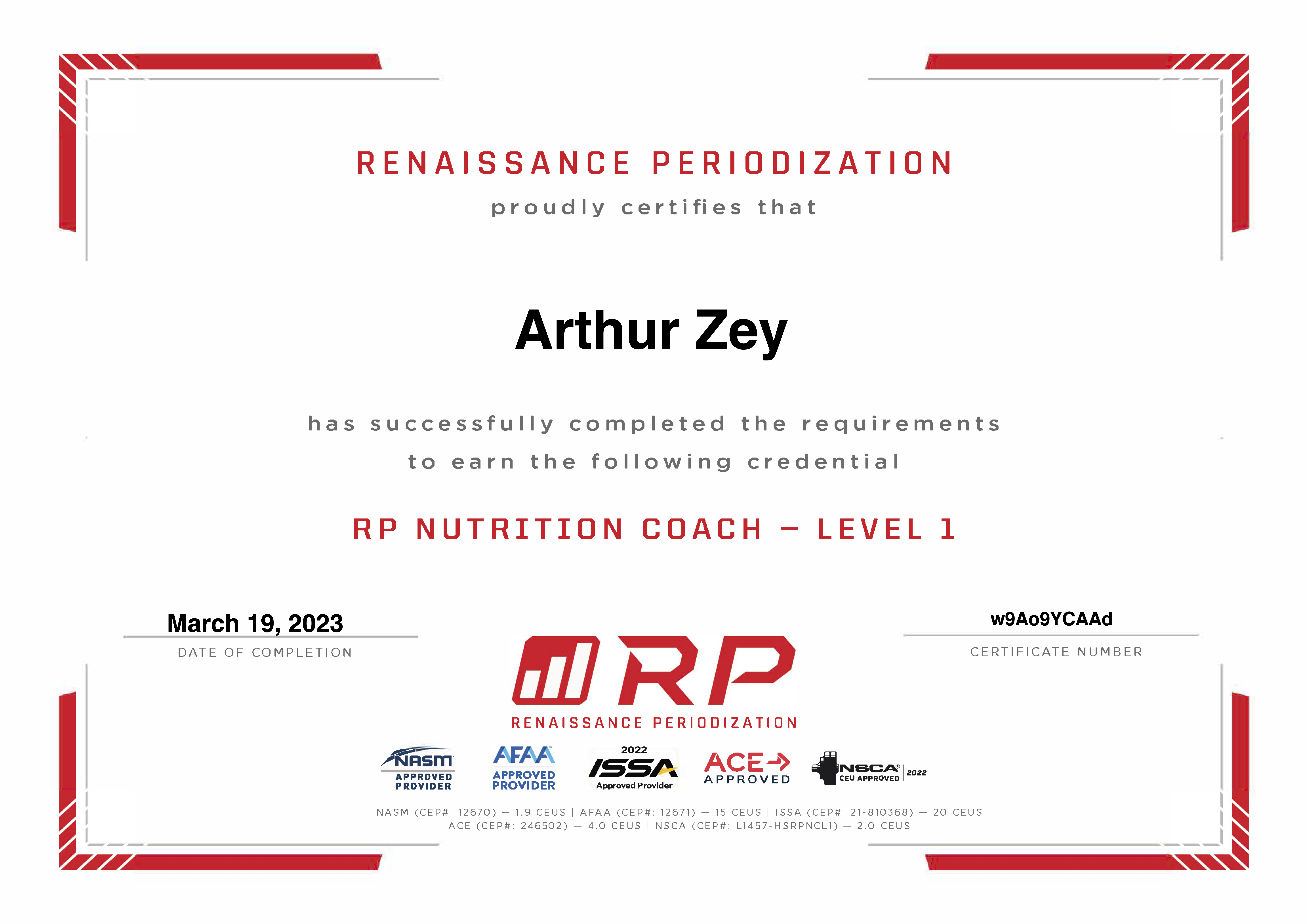
In 2023, I formalized my nutrition expertise by earning my Certified Nutrition Coach credential from Renaissance Periodization:
I began working with clients on nutrition and physical development, helping them apply structured, evidence-based approaches in a way that fit their lives.
What became clearer and clearer to me, through both my own development and my work with others, is that the challenge is rarely a lack of knowledge. (Otherwise, everybody could just use an LLM!)
It's applying that knowledge consistently, especially in the context of a real life with competing demands, stress, and imperfect conditions.
That's where I focus my work.
My background in systems thinking, philosophy, and human behavior shapes how I approach coaching. The work is not a narrow discipline: It spans multiple aspects of life.
Working With Me
I don't come to coaching from a single narrow lane.
My perspective is shaped by
- a foundation in mathematics and analytical thinking
- years of philosophical study and application
- sustained engagement with psychology, communication, and emotional development
- decades of experience designing systems and solving real-world problems
- and a long, personal investment in improving my own development across multiple dimensions
I bring that perspective to helping people navigate the practical challenges of improving their lives, whether the catalyst that brings them to me is physique, emotional wellbeing, intellectual growth, or any other aspect of health and fitness.
If you're looking for a thoughtful, structured approach, someone who can help you make sense of competing ideas, and guidance that holds up outside ideal conditions, this work may be worth considering.
See how coaching works View coaching options
Curious to learn more about the nerd behind the coach? I'm an open book: